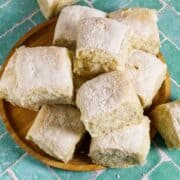
Waterford Blaas (Traditional Irish Bread Rolls)
This Waterford blaas recipe makes traditional Irish bread rolls with flour-dusted tops and crisp bottoms. Baked close together, these soft rolls are perfect for Irish breakfast sandwiches or serving with soup.
Servings: 12 blaa rolls
Calories: 210kcal
Equipment
Ingredients
- ⅔ cup warm water 105-110°F
- 1 ½ tablespoons dry active yeast (.5oz/14g)
- 1 teaspoon sugar
- 5 ½ cups bread flour (1 ¾ lbs/780g)
- 1 teaspoon salt
- 1 ⅓ cups additional water
- cup additional flour about 3 tablespoons for pan bottom and 3 tablespoons for dusting the tops
Instructions
Activate the Yeast
- In a small bowl or measuring cup, combine the warm water, yeast, and sugar. Stir until dissolved and let sit about 5 minutes, until foamy.⅔ cup warm water, 1 ½ tablespoons dry active yeast, 1 teaspoon sugar
Make the Dough
- In a large bowl, mix the flour and salt together with a whisk.5 ½ cups bread flour, 1 teaspoon salt
- Add the yeast mixture to the flour. Add the remaining water gradually while mixing with a wooden spoon or stand mixer fitted with a dough hook. Mix until the dough forms a soft ball and pulls away from the bottom of the bowl.1 ⅓ cups additional water
- Knead by hand or with the dough hook for about 5 minutes, until the dough is smooth and elastic.
First Rise
- Place the dough in a lightly oiled bowl, cover, and let rise in a warm spot for about 1 hour.
- The dough should double in size. If you press a finger into it and the indentation remains, it is ready.
Second Rise
- Punch down the dough to release the air and return it to the bowl. Let rise again for about 30 minutes.
Shape the Rolls
- Turn the dough onto a lightly floured surface and divide into 12 equal pieces, about 90 g (3 oz) each.
- Preheat your oven to 425℉, but do not grease the baking pan. Roll the dough into smooth balls. Evenly sprinkle about 3 tablespoons flour across the bottom of the baking pan before placing the rolls about 1 inch apart in a 9×13-inch pan.cup additional flour
Final Rise
- Dust the tops of the rolls lightly but evenly with about 3 - 4 tablespoons of flour, then cover the pan with plastic wrap. Let the rolls rise again for 30 to 45 minutes.
Bake
- Bake in a preheated 425°F oven for 20–22 minutes. The bottoms should be crisp while the tops remain pale.
Notes
- Measure flour carefully: Use the spoon and level method or weigh the flour to avoid adding too much. Excess flour makes the dough stiff.
- Use properly warm water: Water around 105 to 110°F activates the yeast without damaging it.
- Allow all three rises: Each rise contributes to the flavor and springy texture of the finished rolls.
- Bake the rolls close together: Placing the rolls about one inch apart allows them to rise upward while keeping the sides soft.
Nutrition
Calories: 210kcal | Carbohydrates: 42g | Protein: 7g | Fat: 1g | Saturated Fat: 0.1g | Polyunsaturated Fat: 0.4g | Monounsaturated Fat: 0.1g | Sodium: 197mg | Potassium: 62mg | Fiber: 2g | Sugar: 1g | Vitamin A: 1IU | Vitamin C: 0.002mg | Calcium: 10mg | Iron: 1mg
